
To this day, many steamed bun shops and small-to-medium workshops still rely heavily on manual craftsmanship. From kneading dough and filling to shaping, almost every step of the process depends on accumulated experience. As long as the master chefs are present, the production line runs smoothly; however, once there is a labor shortage, overall throughput and quality are easily compromised.
In the past, by relying on skilled masters and long hours, shops could still produce tray after tray of products. But in recent years, as labor shortages become the norm and training new staff becomes difficult—coupled with the rise of delivery services, group buying, and retail channel orders—the traditional manual-heavy production model is struggling to keep up with actual demand. As production scales up, issues such as inconsistent sizes, uneven dough-to-filling ratios, and difficult-to-control lead times begin to surface, leading many business owners to question:
Can relying solely on manual labor and experience still sustain our future business scale?
Table of Contents
I. 3 Common Challenges for Steamed Bun and Mantou Producers in Mass Production:
① Difficulty in Replicating Experience; High Reliance on Manual Labor for Stability
The steamed bun, bakery, and flour-based product industries have always been particularly dependent on manual labor and master experience. This is primarily because raw materials have characteristics such as high hydration, strong stickiness, and significant fermentation variance. The actual state of the dough changes easily with temperature, humidity, and time, requiring on-site personnel to make real-time adjustments based on judgment.
Processes such as filling, shaping, and tray-arranging may seem familiar, but they actually rely heavily on a "feel" and operational rhythm accumulated over a long time. Once key personnel take leave, rotate shifts, or resign, the production rhythm, product quality, and delivery schedules are often immediately affected.
② Sudden and Concentrated Peak Orders; Labor Cannot Scale Simultaneously
When holiday seasons or retail demands arrive, order volumes often explode in a short period—such as stock preparation before the Lunar New Year, peak gifting seasons like Dragon Boat and Mid-Autumn festivals, or when retail promotions and group-buying events launch simultaneously. Production lines must often complete massive volumes within a limited timeframe.
However, labor costs, maximum working hours, and physical fatigue are often already at their limits. Increasing temporary labor is not only difficult but also fails to guarantee quality stability. For producers, the real bottleneck isn't "whether to take the order," but whether the current production line can actually sustain such a volume.
③ Rising Quality Standards; Mass Production Stability Becomes the Biggest Challenge
As consumer demands for food texture, appearance, and consistency continue to rise, it is no longer enough for a product to simply "taste good." It must maintain the same standard across every batch and every single piece. Especially in the gift market, consumers have higher expectations for uniform appearance, consistent size, and product stability, leaving almost no room for compromise. However, under mass production, manual processes are prone to fluctuations in texture and appearance due to operational differences, inconsistent rhythms, and personnel fatigue, making quality control increasingly difficult.
II. Implementing Automation for Steamed Bun and Mantou Producers: It’s Not Just About "Which Machine to Buy"
The most common issue many flour-based, bakery, and snack food producers face when introducing automation is not that the equipment is poor, but that they "bought the right machine but didn't solve the production line problem."
In reality, the key to production efficiency has never been just the specifications of a single piece of equipment; it is whether this equipment can be smoothly integrated into the existing line and operate stably with upstream and downstream processes. On an actual production floor, a single fast-running point does not equate to a smooth entire line. If new equipment cannot effectively interface with pre-processing, filling, shaping, or downstream conveying, even a full-featured machine will suffer from inconsistent rhythms and frequent downtime for adjustments during mass production. This increases the labor burden on-site and significantly diminishes the effectiveness of automation. The choice of equipment must always return to the "product itself."
Different products have inherently different process requirements:
- Steamed buns and mantou products emphasize dough-to-filling ratios, weight consistency, and appearance stability, requiring particularly high precision in the filling and forming stages.
- Bakery and bread products focus more on dough elasticity and whether the forming process affects the fermentation structure.
- Fish balls and surimi products rely heavily on the physical properties of the filling and the stability of continuous extrusion; any jamming or interruption directly impacts the texture.
Therefore, the focus of automated equipment planning is not to force the production line to adapt to a specific machine, but to select the appropriate equipment configuration based on product characteristics, expected output, and on-site workflows. Only when equipment can maintain a consistent rhythm across different items and volume demands can automation truly translate into production efficiency and operational flexibility.
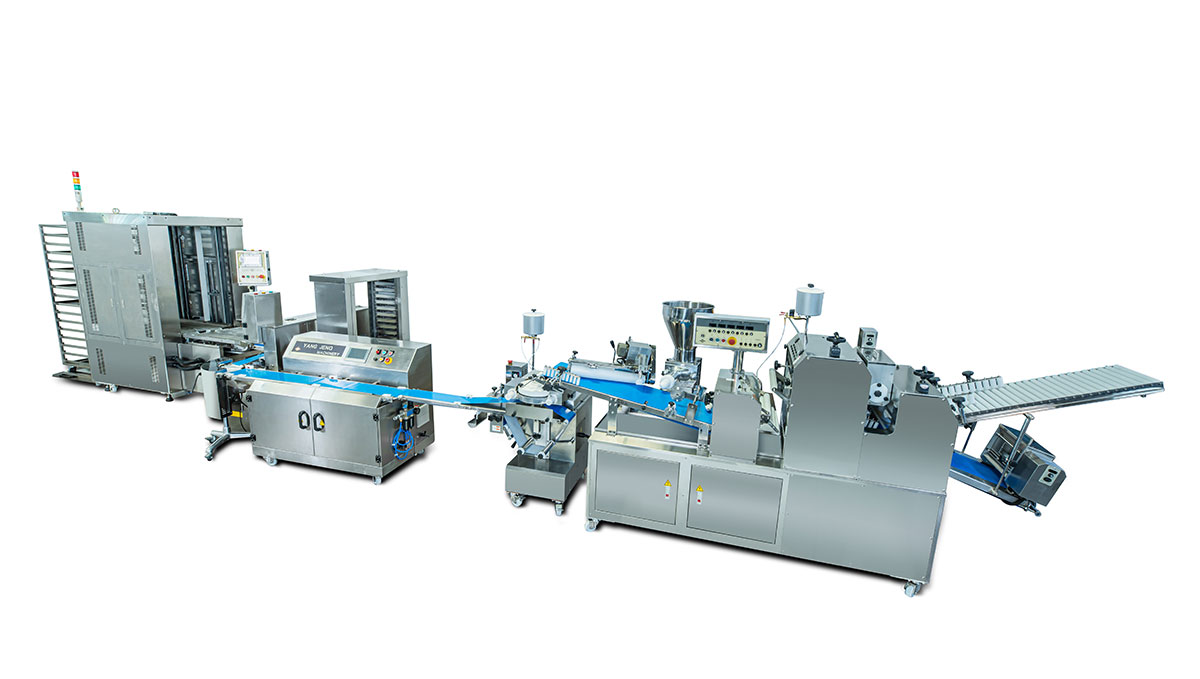
III. 【Case Study】 Automatic Steamed Bun Production Line | From Manual Production to Stable Automated Mass Production
Customer Background
The client is a market-based wholesale steamed bun producer, operated by family members. Their products have long been favored by the market, accumulating a stable base of repeat customers and receiving continuous wholesale orders from vendors and retail channels. As order volumes grew, the original manual-heavy production model began to show limitations in throughput and stability.
Before Implementation | Production Bottlenecks Under Manual Mode
Before implementing the equipment, the entire production process relied completely on manual labor, with approximately 4–5 people responsible for filling, shaping, and finishing. To meet order demands, working hours often extended to 10–12 hours. Even so, overall capacity remained restricted by labor and time constraints, with actual output being only about one-third of what the subsequent automated line achieved.
As production scaled, labor became the ceiling for capacity. Production stability and quality consistency also came under pressure, making it difficult for the production side to steadily handle larger, sustained wholesale orders.
After Implementation | Production Issues Solved by the Automatic Steamed Bun Line
① Maintaining Dough Structure Integrity to Prevent Texture Degradation During Mass Production
During mass production of steamed buns, if the dough is repeatedly subjected to high pressure in high-speed processes, the tissue can easily be damaged, resulting in a tough texture.
Through a three-stage progressive dough sheeting process, the dough sheet is gradually extended during forming rather than being forcefully squeezed all at once. This effectively reduces the risk of structural damage, ensuring the bun skin retains its elasticity and excellent mouthfeel even under mass production conditions.
② Stable Control of Filling Weight and Appearance Consistency
In manual processes, filling weight and appearance depend heavily on the staff's condition, leading to discrepancies as working hours lengthen.
After implementing the automatic steamed bun machine, stable filling settings allow for continuous control of dough-to-filling ratios and forming conditions. This ensures every bun maintains a consistent standard in weight and appearance, reducing batch-to-batch quality fluctuations and enhancing overall mass production stability.
③ Adapting to Various Filling Characteristics to Ensure Continuous Operation
Steamed bun production often requires process adjustments for different filling types, including meat, vegetable, bean paste, and even fluid fillings.
Through independent filling and forming designs, adjustments can be made based on the physical properties of the filling. This ensures various types of fillings operate stably under mass production, reducing jams, interruptions, or forming defects, and guaranteeing production continuity and a stable rhythm.
Related Page:Automatic Steamed Bun Production Line Introduction
IV. 3 Key Supports from Yang Jenq | Full Planning for Automatic Steamed Bun and Mantou Machines
When implementing automation, what many central kitchens and food factories truly worry about is never "whether the machine will run," but rather, "will the line be smooth, can the staff operate it, and will the quality remain consistent" after the purchase. Therefore, regarding equipment implementation, Yang Jenq provides more than just the machinery; we offer a set of production line supports that can be practically executed on-site.
① Operational and Technical Guidance for Immediate Production
After equipment delivery, we provide operational instructions and key guidance based on actual production line conditions. This helps on-site personnel get up to speed quickly and prevents unfamiliarity with the equipment from affecting line stability.
Through standardized operating procedures, reliance on a single master chef is reduced, ensuring that throughput and quality remain consistent even with personnel rotations.
② Practical Recommendations Based on Product and Line Conditions
Different products vary significantly in dough thickness, filling ratios, hydration levels, and forming methods.
Leveraging long-term food processing experience, Yang Jenq assists in identifying key process differences during the implementation stage and provides corresponding adjustment directions, ensuring the equipment fits the product rather than forcing the product to accommodate the equipment.
③ Process Support for Special Items to Reduce Trial-and-Error Costs
For products with high stickiness, non-standard recipes, or special forming requirements, we provide practical implementation advice. This helps factories avoid common process risks in advance, reducing raw material waste caused by repetitive testing and shortening the implementation period.
Through this implementation support, factories do not have to bear the risks of trial and error alone during the transition to automation. Instead, they can complete production line upgrades in a predictable and controllable state.
V. FAQ
FAQ 1 | Under what circumstances should a steamed bun shop start evaluating an automatic steamed bun machine?
The critical time to evaluate an automatic steamed bun machine is when production volume scales up and working hours stretch longer, yet orders still cannot be delivered consistently.
Many steamed bun and mantou producers rely on master experience to sustain production initially. However, as order volumes increase, labor shortages become a norm, or quality consistency comes under pressure, relying solely on manual labor becomes unsustainable in the long term. Implementing an automatic machine at this stage helps shift capacity and quality from "reliant on people" to "stable operation through processes."
FAQ 2 | Will implementing an automatic steamed bun machine affect the texture or "handmade" feel of the buns?
Not necessarily; the key lies in whether the equipment design and process planning are adequate.
Through progressive dough sheeting, stable filling control, and independent filling designs, automatic steamed bun machines can maintain dough structural integrity under mass production, avoiding the texture degradation caused by excessive squeezing. With correct process settings, automation does not sacrifice quality; rather, it transforms results that once relied on a master's "feel" into replicable, stable quality that can be maintained over long periods.
FAQ 3 | What is the most commonly overlooked factor when implementing an automatic steamed bun machine?
Many producers tend to focus only on "machine specifications" or "single throughput figures," overlooking whether the equipment can smoothly interface with existing lines, product characteristics, and operator habits.
The real impact on implementation success often depends on whether upstream/downstream process integration, practical operational guidance, and process adjustment support are in place. The key to a successful transformation is the ability to maintain stable mass production across different fillings, output volumes, and personnel rotations.