
When evaluating encrusting machines, many food producers initially focus on production speed, price, or machine size. However, once actual mass production begins, they discover that the key to production stability is not just whether the machine "can encrust," but rather——whether the production line can remain stable even when raw material conditions fluctuate.
If filling moisture, oil ratio, particle size, or ambient temperature and humidity change slightly, equipment with insufficient adjustment flexibility can easily experience inconsistent extrusion or rhythm shifts. This ultimately affects product appearance, weight consistency, and even overall throughput.
This is precisely why many factories, after implementing automatic encrusting equipment, find that the real bottleneck isn't speed, but the equipment's ability to handle "variability."
Table of Contents
I. Let the Product Speak: Encrusting Machine Design Differences Are Hidden in Mass Production Details
Products like encrusted fish balls, mochi, tangyuan (glutinous rice balls), and soup dumplings (xiao long bao) inherently have vast differences in skin elasticity, filling moisture content, and oil ratios.
Even with the same recipe, significant changes in physical properties can occur across different batches, climates, or operating times.
Common scenarios in actual mass production include:
- The same machine runs Product A very smoothly.
- As soon as it switches to Product B, speed must be reduced.
- Issues like off-center filling, broken skins, or filling leaks begin to emerge.
On the surface, these issues may seem like problems with operation or recipe adjustment. However, in essence, they are often highly related to the "structural design" and "adjustability" of the equipment itself. The key that truly separates encrusting machines is not "making one specific product exceptionally well," but rather —— whether the equipment can quickly adjust and return to a stable state when raw material conditions change.
II. Two Most Overlooked Key Designs When Choosing an Encrusting Machine
Key 1 | Whether Dough and Filling Can Have "Independent Speed Control"
In the mass production of products like bread and steamed buns, if the moisture or oil ratio of the filling changes even slightly, and the dough and filling are linked by a single control, the encrusting rhythm often cannot be corrected in time. This easily leads to broken skins, off-center filling, or leaks.
With an encrusting machine featuring "Independent Speed Control for Dough and Filling," operators can make fine adjustments without stopping the machine, allowing the encrusting rhythm to return to a stable state immediately. This design ensures that the production line no longer relies entirely on a master's experience but instead maintains stable mass production as raw material conditions change.
Key 2 | Whether High-Stickiness Materials Can Truly Achieve "Long-Term Mass Production"
For products like mochi, daifuku, Taiwanese meat pies (Ba-wan), and crystal dumplings, high stickiness and high elasticity often mean the following on many market models:
- Extrusion pulling and deformation
- Destruction of the final product texture
- Required speed reduction or only short-term production capabilities
If the equipment lacks a corresponding design in its feeding and extrusion structures, high-stickiness products often find it difficult to enter a true continuous mass production state. Therefore, whether the machine can maintain smooth extrusion without pulling the skin or causing deformation during high-speed operation is a critical indicator of an encrusting machine's mass production capability.
III. Core Value of Multi-Function Encrusting Machines: Adapting to Raw Material Variations and Maintaining Line Stability
In a real mass-production environment, the true challenges are usually not about a single product, but rather:
- Different physical properties of fillings
- Different recipe conditions
- Different seasonal demands and output requirements
The core value of a multi-function encrusting machine is not just the ability to make more products; it is about providing the production line with sufficient adjustment flexibility and stability when facing variations, avoiding forced speed reductions or line shutdowns due to equipment limitations.
IV. Practical Application Analysis | How YJ-900T Solves High-Stickiness Mass Production Pain Points
Why do most encrusting machines have to slow down when encountering high-stickiness fillings?
Under high-fat or high-stickiness filling conditions, traditional feeding structures easily cause oil leakage or structural damage due to squeezing or pulling. This ultimately affects skin integrity and finished product texture.
Learn more: YJ-900T Multi-Function Encrusting Machine Features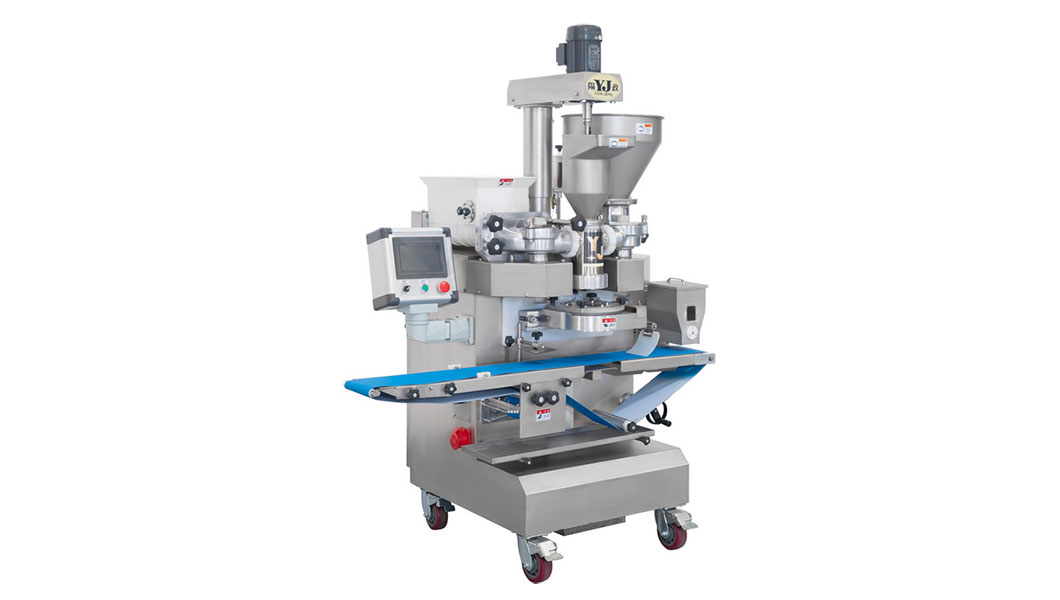
Key Design Differences of YJ-900T
The YJ-900T utilizes a dual-feeding design with a vertical screw + horizontal auger. This allows different filling properties to choose the most suitable feeding method based on requirements, rather than forcing all products through a single structure.
| Feeding Method | Applicable Filling Types | Common Mass Production Issues | Design Focus | Practical Benefits |
|---|---|---|---|---|
| Horizontal Auger Feeding | High-stickiness, high-fat fillings (e.g., lotus seed paste, bean paste, fruit filling) | Oil leakage, structural damage, incomplete skin | Replaces high-pressure extrusion with stable pushing, ensuring even force during transport and reducing structural damage risks. | Fine filling texture, stable oil condition, intact skin without breakage; ideal for long-term continuous mass production of high-stickiness fillings. |
| Vertical Screw Feeding | Low-stickiness, loose fillings (e.g., mixed nuts filling, paste filling) | Clogging, material interruption, inconsistent weight | Uses a vertical screw feeding method to minimize over-mixing of filling and dough, preserving the raw ingredients' original flavor. | Stable extrusion rhythm helps control consistency in product weight and appearance, enhancing mass production quality stability. |
V. Design Core of Yang Jenq's Multi-Function Encrusting Machine Series
The design of Yang Jenq's multi-function encrusting machine series does not merely pursue single production speed metrics. Instead, the core R&D and model selection logic starts from the physical properties of fillings and the stability of long-term mass production.
| Design Core | Key Explanation | Practical Impact on Production Lines |
|---|---|---|
| Feeding Structure Selection Based on Filling Characteristics | Depending on the model, vertical screw or horizontal auger feeding methods are configured. This allows for selecting the most suitable dropping and pushing structure for high-stickiness, high-fat, or loose fillings, reducing the risk of clogging and inconsistent filling volume. | Feeding methods can be adjusted for different filling properties, helping to reduce abnormalities during production and enhancing overall mass production stability. |
| Prioritizing Mass Production Stability Over Just Production Speed | When assisting clients with encrusting machine recommendations and evaluations, Yang Jenq comprehensively considers filling properties, product types, and production line conditions to ensure the equipment maintains stable performance during long-term continuous operation. | Prevents sacrificing long-term operational stability for short-term high speeds, helping to reduce downtime risks and reliance on manual labor. |
| Clear Distinction Between "Showcase" and "Mass Production" Equipment | The key to stable mass production is not "how fast it runs,"but"whether the performance is consistent over a long run." This is the most overlooked yet most impactful difference during encrusting equipment selection. | Assists users in more clearly judging whether equipment fits actual mass production needs during the selection stage, avoiding subsequent line adjustment costs due to choosing the wrong equipment. |
If you are currently in the equipment selection stage, please visit our Encrusting Machine Category Page to further understand the design differences and practical application scenarios of the Yang Jenq Multi-Function Encrusting Machine series. This serves as an important reference for planning a stable, long-term production line.
VI. FAQ
FAQ 1 | Is it really not enough to only look at production speed and price when choosing an encrusting machine?
It is not enough.
Production speed and price only reflect the equipment's performance under "ideal conditions." However, actual mass production often encounters fluctuations in filling moisture content, oil ratios, particle sizes, or ambient temperature and humidity. If the equipment lacks adjustment flexibility, even a high rated speed won't prevent inconsistent extrusion or product variance during mass production, which ultimately harms overall throughput and yield. When evaluating an encrusting machine, the key is whether it can maintain stability under raw material variations.
FAQ 2 | Are multi-function encrusting machines truly more suitable for mass production? Or can they just make more types of products?
The value of a multi-function encrusting machine isn't just about making more types of products; it’s about the ability to adjust the process according to different filling properties and production line conditions.
In real mass production, true challenges stem from recipe differences, seasonal shifts, and output scale-up demands. A multi-function encrusting machine with independent speed control and various feeding structure options can quickly stabilize the process without frequent shutdowns, making it more suitable for production environments requiring long-term, stable mass production.
FAQ 3 | What key conditions should be prioritized when recommending an encrusting machine?
When evaluating encrusting machine recommendations, it is advised not to look at a single product or rated capacity alone, but to start from the overall production line conditions, including:
- Stickiness, oil content, and particle structure of the filling
- Requirements for long-term continuous mass production
- Possibility of future changes in products or output volume
- On-site operator experience and frequency of adjustments
The ability to maintain stable mass production under these conditions is the critical indicator that distinguishes "showcase" equipment from true mass-production-grade equipment.